Category Archives: Uncategorized

Month on the Air

Month on the Air is our day-by-day list of what’s happening on air – DXpeditions, Special Event Stations, Contests, etc. Here are the last two month’s editions, now showing Contest day as well as date.

To view one full size, click on the file name or the download button below the displayed PDF and change the Zoom from Automatic to 100% or Actual Size from the dropdown menu, from which it can then be printed or saved using the >> button at the top right.

January 2026

December 2025

November 2025

October 2025

September 2025

August 2025

July 2025


June 2025

May 2025

April 2025

March 2025

February 2025

January 2025

November 2025 Meeting: EGM and Show & Tell

EGM

The meeting this month started with an Extraordinary General Meeting, to vote on a change to build the role of our contest coordinators: to give them greater status and voice to those who progress a key club objective – contesting. It would give our coordinators greater input to discussions
on the club’s programme and equipment. The coordinators would become full members of the committee, and their roles would be given in the club constitution.

Our chairman Mike M0RYK/F4VRD introduced the proposal, which was seconded by Phil G3MGQ and Barclay 2E0WOH, and on a vote, was accepted unanimously.

The updated WKARS Constitution has now been published, and is shown on the Downloadable Files page.

West Kent Amateur Radio Society has some of the most enthusiastic contest operators, keen to progress in the many contests we follow, covering all the main contest modes: voice, CW and data. In order to effectively take part in HF contests and increase our standing in the various RSGB contest results, and to be seen as an active radio society, we need a HF contest coordinator! Please contact us via mailto:secretary@wkars.org.uk if you feel you could contribute your energy and enthusiasm for contesting!

In other news, we have had another successful training session with three young students; we are soon to train a further fourteen students from a local school. The school are to set up a station in January, with the support of the physics department, with donated transceiver, feeder, antenna and books. WKARS have trained over twenty students this year.

Show And Tell!

Matt M0CUV gave a demo of attempts to build a packet radio station using a pair of Quansheng UV-K5(8) transceivers. As the popular APRS-K1 Cable does not key the PTT, it requires VOX operation, which takes time to key the transmitter, so the start of transmitted packets can be lost. A better solution is to use an interface that handles PTT directly, such as the Mobilinkd TNC4, which is a £116 KISS modem that can be controlled by APRS software such as Xastir. Mobilinkd’s first version was an Arduino-based KISS modem that they published as Open Source/Hardware with full breadboard build instructions. Matt built one of these which is working for transmit, but not yet for receive (to be investigated). Using a Baofeng UV-5RH Pro that transmits its position via APRS periodically, Matt demonstrated the DireWolf sound-card modem listening to the first Quansheng connected to a LogiLink USB TRRS Sound Card via an APRS-K1 cable. This decoded the Baofeng’s APRS data. He showed Xastir sending location information to this breadboard KISS modem, which transmitted on the second Quansheng. DireWolf (listening on the first radio) could decode this successfully. This is all using 1200 baud AFSK, with the Quanshengs being suited to voice. An upgrade from the Quansheng, providing a better option for 9600 baud packet is the VGC VR-N76 Dual Band Handheld which has a flat response.

Chris G6HTH gave a cautionary talk about contingency planning. There are many aspects of modern life that can go wrong, causing significant stress – in order to reduce this, you could plan for these eventualities, write down what you would need to do in the event of emergencies, and most importantly DON’T PANIC! For example, in your house, where are all the stop cocks, and what do they do? Where is the fuse/distribution board? Ensure you have got readily-available charged batteries for essential devices, with the manuals easily available. Do you have lightning protection for your aerials? Do you have a backup plan for the event of living without essential amenities for a prolonged period? Do you know where your passport and driving license is? If you have an emergency generator, is it in working condition? Do you have sufficient fuel for cold weather? Do you have a small store of food in case the shops run low, or if you cannot get to the shops? Do you have a small amount of emergency cash available?

With the subject of emergencies on our minds, Chris G6AHK and Mike M0RYK recalled several incidents where what should not go wrong, did.

Malcolm G4FWG demonstrated his collection of antique torches – several of which were hazard area approved. The bulbs had been replaced by MES style LED units, and batteries modernised. Several design elements of the torches were shown, and how these led to the torches being usable in hazardous environments.

Mike M0RYK demonstrated the zBitx from HF SIGNALS, (Ashhar Farhan, VU2ESE) – the zBitx is a portable SDR QRP transceiver, powered by a pair of 18650 batteries. 5 Watts, all modes from CW, SSB, FT8, all bands 80m to 10m. It arrives in around 15 days, pre-built, with a test certificate, and the construction is undertaken by a women’s collective in India, providing them with a livelihood. It costs $197.

During our tea break, Matt M0CUV showed photos and performance graphs of his latest loft-based QRP four-band fan dipole, that’s suspended from the rafters by strips of plastic from soft drinks bottles, and fed by a SOTAbeams HF 1:1 125w balun. The elements are spaced about 3cm apart, and interact, meaning that adjustment is a repetitive process – but it’s in the loft, so this doesn’t require climbing a tower, and there’s no weatherproofing necessary. The ends are held aloft by string, hence the antenna’s name, The String Quartet. It’s resonant near the FT8 frequency on 18, 21, 24 and 28MHz.

Loudspeakers and Microphones with Chris G6HTH

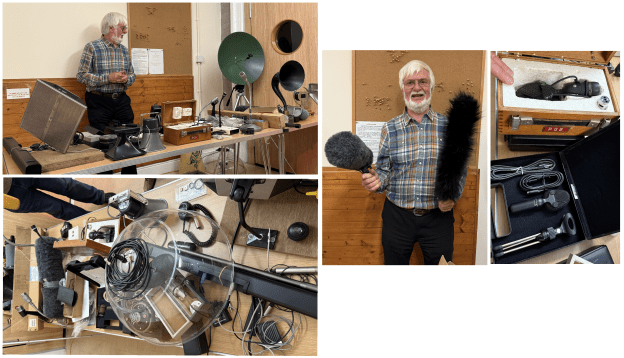
On Monday 13th Oct, Chris G6HTH gave a great talk on loudspeakers and microphones, their history, development and some of the technologies involved.

To aid his talk, Chris brought many items from his collection, as can be seen on the table above – some items from the earliest developments to modern replacements:

  • Horn loudspeaker at the right of the table, with black curved horn that’s mounted on a compact but heavy driver, and adapts the sound emitted to match the free space.
  • A Coles 4038 Microphone, shown in the box on the right, surrounded by polystyrene. This ribbon microphone had a label showing its BBC patents, and has a wide, flat frequency response. Heavy, and producing a substantial magnetic field. Shown below is a modern homage to it, a Behringer BV4038 USB-C Microphone, much smaller, but with an “inspired design from a highly popular waffle-iron studio microphone used during 1950s” – and giving excellent response.
  • From tiny transducers to gun microphones, subject-isolating mics, lip microphones for capturing only the announcer’s voice, lavalier microphones, fist mics, wind screens a.k.a. ‘Dead Cats’ (shown being held by Chris).
  • On the left of the table is a device similar to an LRAD (Long Range Acoustic Device) for projecting sound at volume – used by law enforcement (certainly in the US) for crowd dispersal etc. Find out more with this YouTube video (AOL/Digital Justice).

A great talk! Thanks to Chris G6HTH for bringing his collection!

Raynet-UK and Technology

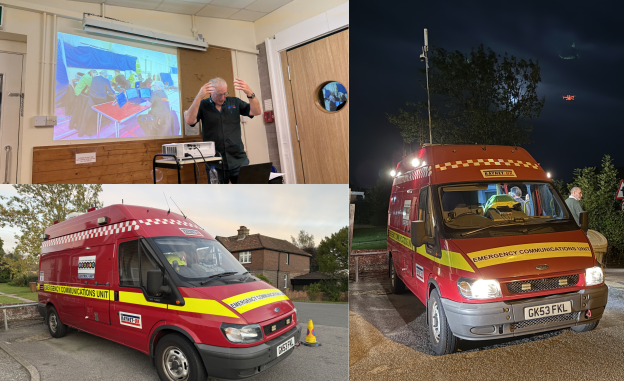
Monday 8th September saw three members of Raynet-UK give an engaging presentation and demonstration of Kent Raynet‘s use of various new technologies to support the emergency services, presented by Colin Bowman M0NLP. Colin went through the history of amateurs supporting the services with our communications expertise – often vital in the event of traditional communications technology being out-of-action. This ranged from our usual FM/UHF/VHF equipment – but deployed for resilience – the use of encryption as needed on the amateur bands when requested by an emergency controller, satellite-based Internet provision for sites without power or other infrastructure, linking this to the telephone network. Various recent deployments of the group’s equipment and expertise were demonstrated.

Seen below, top-left, Colin’s presentation showing a typical group of emergency co-ordinators, including Raynet. Also with Colin were Taylor Galloway 2E0YPU (Group Controller, South Kent Raynet), who demonstrated the facilities provided by the group’s impressive Emergency Communications Unit, shown below and Colin Spice 2E0CMS (Controller, Medway Raynet) – who is also a qualified drone pilot, and who demonstrated use of drones to provide video in emergency situations. The bright orange drone can be seen above the group’s van on the right.

Top left, Colin Bowman discussing an emergency coordination session; Bottom left and Right, the Emergency Communications Unit vehicle and drone.

Thank you to Colin, Taylor and Colin for a highly informative talk and demonstration of Raynet’s capabilities, and what they bring to emergency and training operations, in terms of rapid deployment of resilient communication facilities.

Construction Night at WKARS

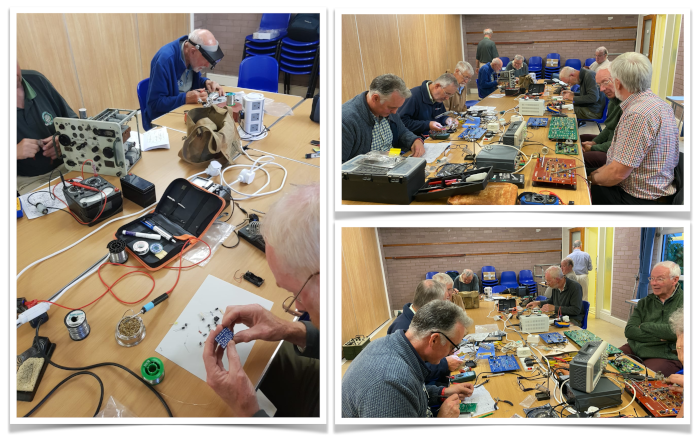
On July 8th we had a construction night at Bidborough, with members building several different types of kits – AM, Airband, FM receivers, amplifiers, Pixie CW HF Transceivers, or working on fault-finding, or restoration of military equipment. Plenty of soldering going on – through-hole and some surface-mount! Kits provided by Chris G6HTH.

Amateur Radio Astronomy at WKARS

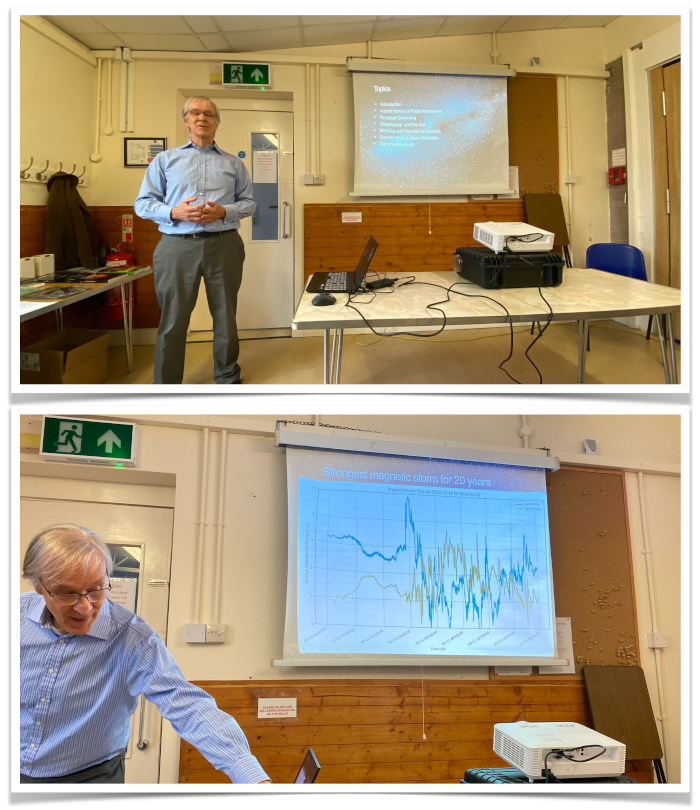
On Mon 13th May we were fortunate to have Andrew Thomas of the UK Radio Astronomy Association give a fascinating presentation on amateur radio astronomy. He covered history, practical observing, geophysics and the sun, and several projects/kits available to the amateur radio astronomer. We had experienced the effects of the solar storm that had occurred only a few days previously – it wiped out the first day of our operations at Nutley Windmill. Andrew added some extra slides on measurements of the storm taken by his instruments, including an impressive graph of his magnetometer signals (shown below) – clearly illustrating the strongest magnetic storm for 20 years. Andrew is not an amateur radio operator, but there is obviously a cross-over between his area of interest and ours.

Mills on the Air weekend 2024

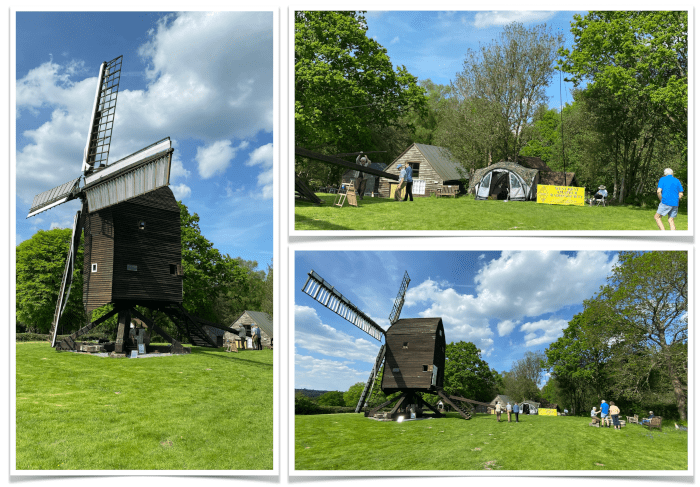
On the weekend of the 11th/12th May, WKARS once again set up our special event station at Nutley Windmill in the Ashdown Forest for ‘Mills on the Air weekend’. One of the sweeps of the mill had become detached last year but has now been restored.

As usual we used the callsign GB2NW for this event, and ran stations covering HF with SSB, CW and QRP FT8. The Saturday was something of a disappointment for us, as the intense solar disturbance that had occurred a day or so before had effectively knocked out worldwide shortwave communications – it did yield some spectacular aurora at night though! Due to this, the number of contacts we made on Saturday were somewhat reduced. The situation improved on the Sunday, where HF made a reasonable recovery.

An on-going tale of two radios, Part 4

By Gordon Bubb G7KNS

Going back to the bad audio output transformer, I gave some thought as to why it had gone bad. Measuring it, not only was it leaking from primary to secondary but the primary was actually open circuit. The thing is epoxy coated and so looks perfect, no signs of overheating.

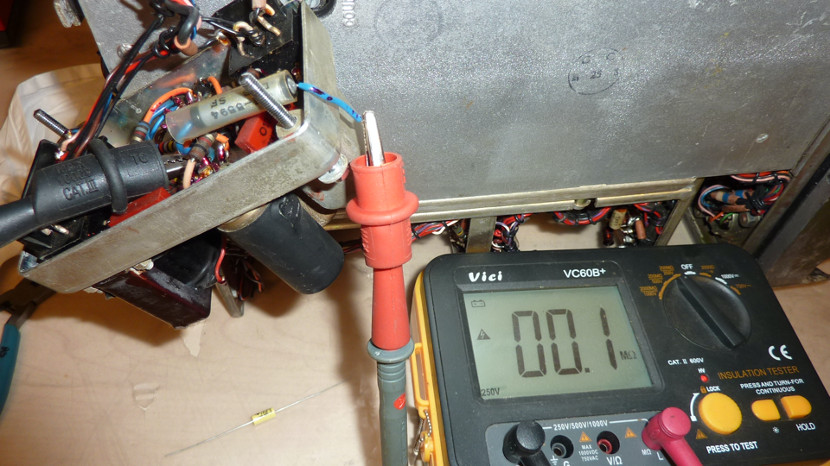
Those of you who work with valve radios will know of the infamous component known as “that capacitor”. This is the capacitor linking the audio driver valve, from the anode at high voltage, to the grid of the output valve which should be at zero volts. If “that capacitor” goes short or leaky the grid goes positive which turns the valve on hard causing excessive anode current which flows through the output transformer…. which is not designed for such abuse, and lays down and dies. In the worst case scenario the mains transformer and rectifiers can also be damaged. So let us check “that capacitor” in this circuit.

Now that is what I call a leaky capacitor! It might not even be a capacitor any more, whatever, straight into the bin with it.

These two radios both have an intercom audio system as well as the radio audio and both systems use the same pattern transformer in very similar circuits. The other three capacitors in question all read in the low tens of megaohms leakage so all were changed, it is just not worth leaving them in place when a replacement costs pennies.

Why do they fail? There are a number of possible causes, mainly old age combined with old fashioned materials and construction methods by modern standards. Remember these components are knocking on 70 years old, well beyond their design life. And yes, there will be others in the sets in a similar condition but none in such a critical location.

On on-going tale of two radios, Part 3

By Gordon Bubb G7KNS

To recap, now both sets are receiving with the same sensitivity. My set does not transmit AM and the ex-Kuwait set has a bad intercom output transformer. Both sets have issues with the in-built crystal calibration system.

As my set does transmit PM and CW there is obviously nothing fundamentally wrong so it is time to think about switch contacts and wiring faults.  Ooh look! Our friend Mr. Bodger has been at this set as well, he gets around doesn’t he?

And again…

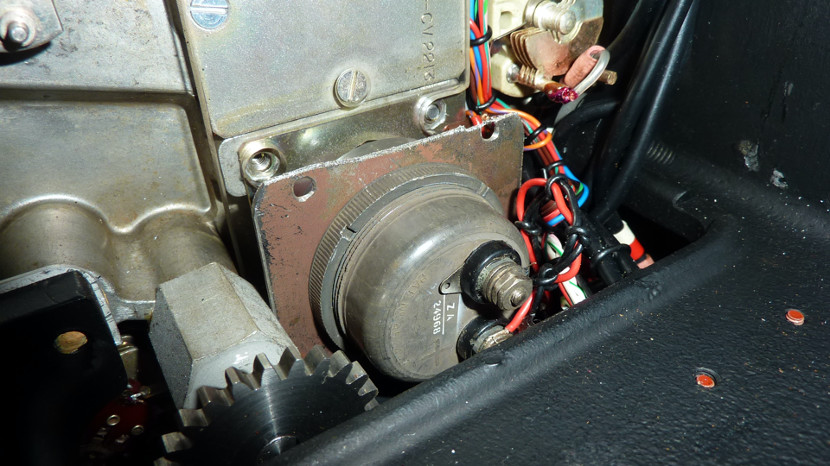
I also found the two wires going to the tuning meter were disconnected. Maybe this is why the calibration system does not work. Then I saw this…

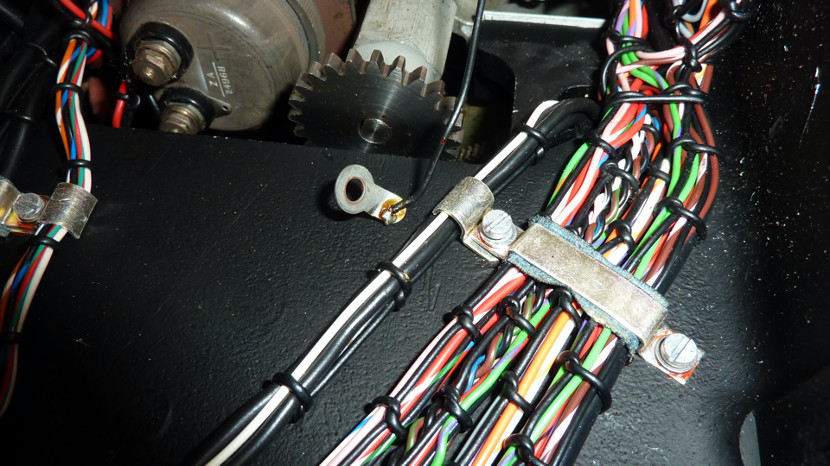
I think our friend has changed the meter but not finished the job. And why butcher the edge of the mounting plate? We won’t ask about the missing mounting studs; the two on the other side hold the plate in well enough. As to why he cut the co-ax instead of unsoldering it, who knows? The end is only an inch away from the cut.

So repair the co-ax, refit the earth tag and reconnect the meter. We now have AM transmit. Result! And there are signs of life on the meter as well now.

The final stage of tuning shows a nice swing of the meter from left FSD (full scale deflection) to right which is correct, it is tuned for centre zero. But the first two stages do not. They use a 100 kc/s (kilocycles per second, this radio predates kilohertz) crystal and according to my oscilloscope it is not oscillating. Swap the module with the one from the other set and all is now hunky dory. One set now fully operational.

Anyone got a spare 100 khz crystal?